
Why Minerva's $20M Bet Exposes the Real AI Bottleneck
The model is rented. The context that makes it useful is not.
The direct answer
Minerva did not raise $20 million to make a prettier chatbot. It raised it to organize the evidence a marketing agent needs before it can make a useful decision.
The company's public launch is a useful market signal, not a verdict on one vendor. Minerva says it unifies first-party data, enriches it with consumer context, and runs workflows through agents. That is the unglamorous work AI programs keep avoiding: reconcile identity, define terms, decide which record is trusted, preserve permissions, and give an agent a governed way to read and act. A model can write a recommendation without this layer. It cannot reliably know whether the recommendation is about the right customer, the current policy, or a metric the business actually uses.
$20M
Minerva funding at public launch
1,000+
attributes in Minerva's identity graph
42%
of CMOs still use GenAI for discrete tasks
2025
Google Data Manager API first release
What Minerva actually raised money to do
Minerva launched publicly with $20 million from The General Partnership, 8VC, Lingotto Innovation, Topology Ventures, NBA Investments, and others. Its stated purpose is practical: make a consumer brand's first-party data coherent enough for an agent to use in marketing work. The platform says it can unify fragmented data, add a proprietary identity graph and more than 1,000 attributes, then support campaign creation, analysis, optimization, and reporting.
That description matters because it moves the conversation away from a familiar category error. An agent is often evaluated as if it were an employee with access to a pile of tools. The more relevant comparison is a new operator arriving at a company with five customer IDs, three definitions of retention, a returns policy split across PDFs, and no reliable way to tell which source should win. It may be able to draft excellent language. It cannot safely decide what is true.
Minerva's launch materials also describe an Agentic Data Engineer that profiles source data, writes transformation SQL, and validates the result. That is a better clue to the opportunity than any model name. A data transformation is not glamorous. It is how the business decides that a loyalty record, a support interaction, an order, and an advertising identifier refer to one person under rules that a human can inspect. If that work is wrong, every downstream AI result inherits the error with more speed and confidence.
The funding does not prove that any brand should buy Minerva. It does reveal where a sophisticated market sees the gap. For years, marketing teams have purchased intelligence as a subscription. The market is now spending on the less visible system that tells that intelligence what a customer, a margin, a campaign, or an exception actually means.
The bottleneck moved
Model quality still matters. It is simply no longer the scarce input most marketing teams think it is. The practical constraint is whether a system can ground an answer in current business context. Does it have the right identity, the right definition, the right source, the right permission, and enough history to understand why this customer is seeing this message now?
BCG's 2026 survey of 300 CMOs puts the distinction plainly. Forty-two percent said they still use GenAI only to assist people with discrete tasks. The CMOs pulling ahead invest in data foundations, brand intelligence, multi-agent orchestration, and talent. BCG defines a brand-intelligence layer as the rules, operating context, KPIs, connections across signals, and trusted sources that help a probabilistic agent interpret data. That is a context layer in business terms.
Gartner's May 2026 warning sharpens the same point: agents need context inputs at every step of a workflow. Without semantic representations of the relationships and rules in organizational data, agents are more likely to be inaccurate, inefficient, biased, and costly. The issue is not that an agent sees too little text. The issue is that it cannot distinguish a definition, a policy, a signal, and an exception.
That is why teams keep paying premium-model prices to reason around a messy stack. The model is asked to infer what a clean system should have already stated. Those inference costs show up as longer prompts, repeated manual corrections, brittle instructions, and output that looks persuasive until someone checks the underlying record. Context work is not a substitute for model capability. It is the condition that lets capability compound.
Anatomy of a context layer
“Context layer” will become vague quickly if it is not defined by jobs. The useful version has five. Each layer reduces a different kind of guesswork. Skipping one does not make it disappear; it pushes the missing decision into the prompt, the agent, or the customer experience.
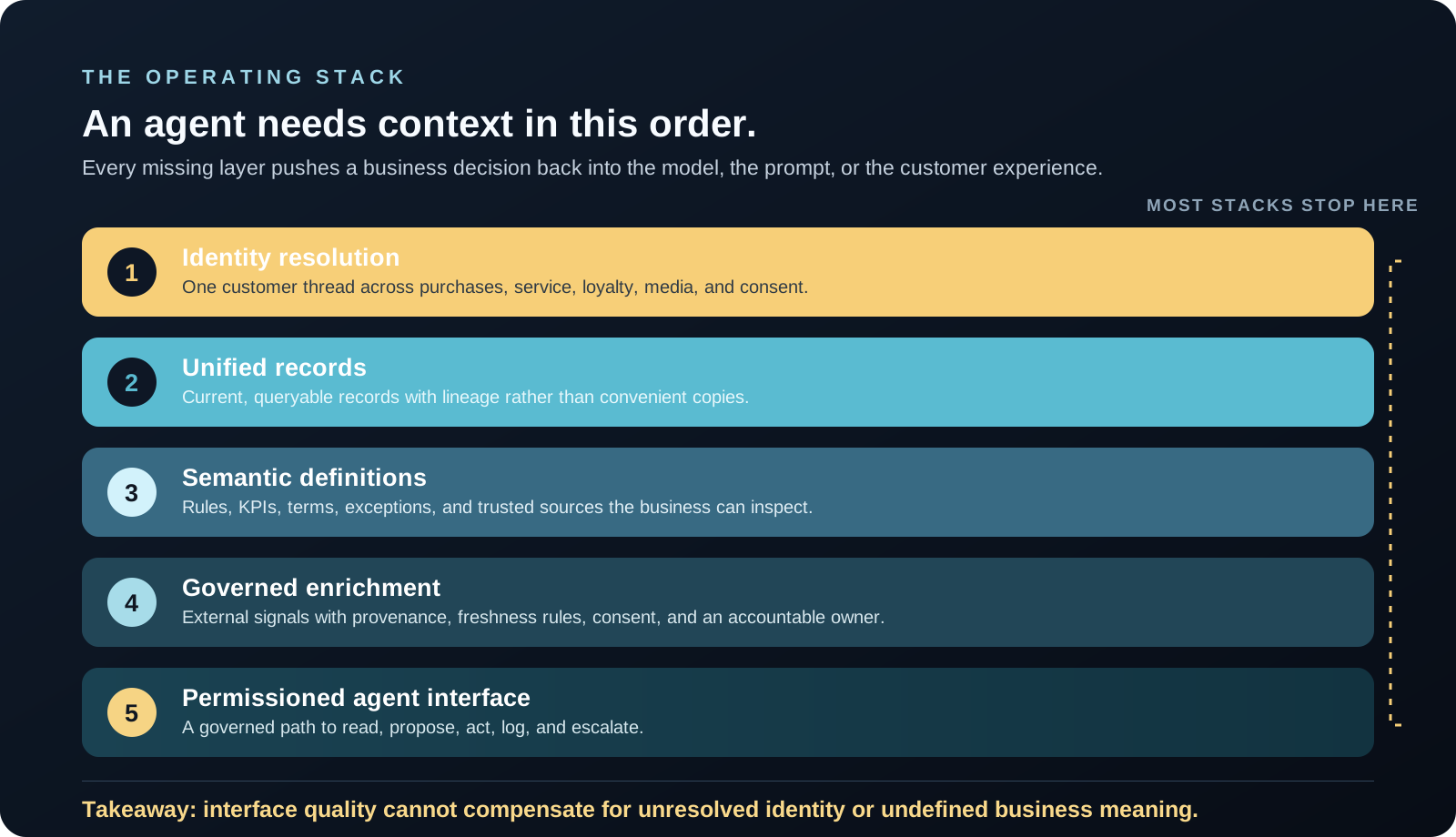
1. Identity resolution. One customer needs one usable thread. The purchase, loyalty balance, support request, email engagement, and advertising exposure may arrive with different identifiers and different update schedules. Identity resolution decides when those records belong together and how confident the system is. Without it, an agent can create a coherent answer about a collection of fragments rather than a person.
2. Unified records. Resolved data must be queryable without a human opening five tabs or exporting a spreadsheet. This can be warehouse-native, virtualized, or provided by a platform, but it must preserve lineage. A record that looks unified while hiding its source and freshness forces the agent to treat a convenient copy as a fact.
3. Semantic definitions. This is the layer most teams miss. What counts as an active customer? Is margin before or after fulfillment? Which offer is valid for a loyalty member? Which campaign metric is the operating KPI? Definitions, relationships, owners, and exceptions need to be machine-legible. The agent should not decide what “VIP” means from a column name and a few examples.
4. Governed enrichment. First-party data records what a customer did. A decision may also require category, inventory, geography, or market context. That enrichment must carry provenance, refresh rules, and a clear owner. Otherwise the context layer becomes an ingestion route for stale or untrusted claims.
5. A permissioned agent interface. An agent needs a governed surface through which it can read context and propose or take action. Permissions, rate limits, logging, versioned definitions, and an escalation path belong here. Context without control produces faster mistakes. Control without context produces a safe but useless assistant.
The first failure mode is a false merge. Identity resolution is not merely a matching exercise. A record can be incomplete, shared by a household, reused after an email change, or linked to a person who withdrew consent. A system that merges too aggressively can send the right offer to the wrong person, expose a service history to someone else, or train a decision on a fiction. The context layer needs confidence thresholds, a way to preserve uncertainty, and a path for a human to correct the link. The useful question is not “can we join these tables?” It is “when should an agent be allowed to act as if this identity is settled?”
The second failure mode is an orphaned definition. A semantic model fails when a term is written once and then drifts away from the operation it describes. A promotion changes, finance revises a margin calculation, or a legal exception is added, while the agent keeps using an older rule. Put an owner, source, review date, and change record beside every definition that can affect a customer, a budget, or an approval. That sounds administrative, but it is how a business gives an agent a reason to stop repeating a formerly correct answer.

Can a new operator tell what a field means without asking around?
If the answer is no, an agent cannot know either. It can only make a plausible guess. The fastest audit is to select ten terms that appear in decisions every week, such as active customer, qualified lead, gross margin, customer lifetime value, or eligible inventory. For each one, ask for a definition, owner, source, calculation, exceptions, and an expiry or review date. The gaps are the part of the AI program nobody can solve by changing a model.
Why the platforms are building theirs
The funding story has a strategic edge. Platforms that want their agents to be useful need customer data organized too. They are not waiting for every advertiser to build a perfect neutral context layer before they offer their own path to unification.
Google's Data Manager API was first released in April 2025 to move audience data into Google Ads and Display & Video 360. Its release history shows the product expanding through audience creation, ingestion, retrieval, offline conversions, and additional destinations. That does not mean Google is trying to become a brand's complete customer system. It does show why the data interface itself is strategic: the party that receives and structures customer context can make its tools easier to use and harder to leave.
This is the leverage warning. If the only coherent copy of a brand's customer context lives inside a platform's walls, that platform's agents get the best brief by default. A suite may be the right choice, especially for a team that has already committed to an ecosystem. But a team should treat definitions, resolved identities, source mappings, and export rights as assets it must be able to recreate elsewhere.
In other words, rent the interface if it helps. Do not rent the meaning of your business back from the interface.
Build, buy, or borrow
There is no universal architecture. The decision is not “platform good” or “warehouse good.” It is whether the approach matches the team's data maturity, required speed, and tolerance for dependency.
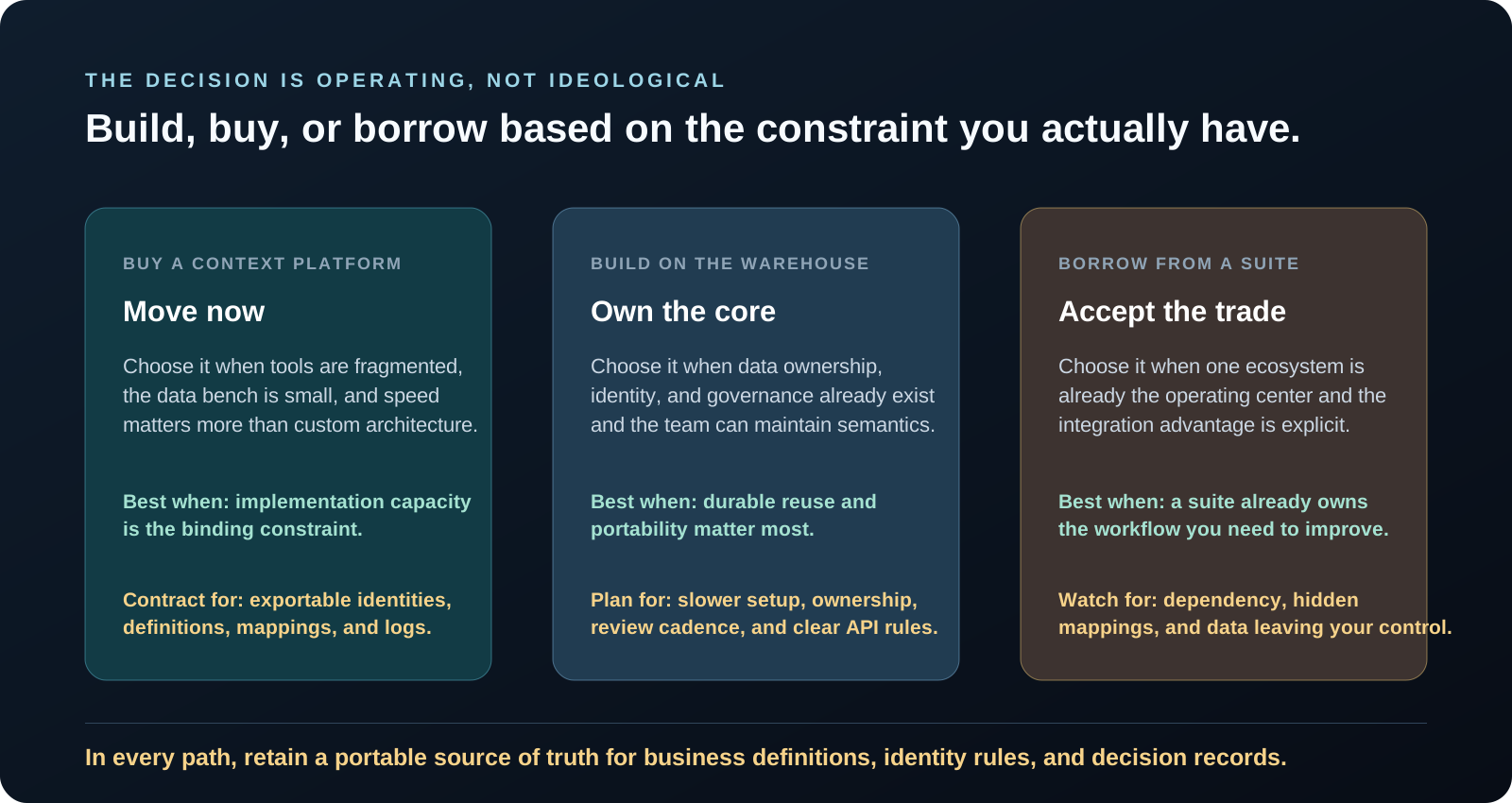
Buy when a consumer brand has fragmented mainstream tools, limited data engineering capacity, and a real need to move now. The vendor must support exports for resolved identities, semantic definitions, and the logic that created material segments. A fast setup is valuable only if the team can inspect the mapping and leave without rebuilding its own business from memory.
Build on the warehouse when the organization already has reliable data ownership, an identity strategy, and people who can maintain a semantic model. It is slower at first, but it leaves the core definitions where the business can govern them. The goal is not to code every agent from scratch. It is to make the trusted business layer reusable by whatever agent, analytics tool, or workflow comes next.
Borrow from a suite when the company is already deeply committed to one ecosystem and the operating benefit is clear. Treat it as an explicit trade: lower integration effort in exchange for more platform leverage. Keep a registry of what was configured in the suite, which data crossed the boundary, and how the company would reconstruct the core layer if terms, pricing, or product direction changed.
The CMO's context audit
A useful audit does not ask whether the team has “enough data.” It asks whether an agent can safely make one real decision without a human quietly filling in missing context. These five questions expose the operating gap.
One customer
Can the team produce one coherent 90-day record across commerce, support, loyalty, email, and media?
Definitions
Do the 20 most-used business terms have an owner, calculation, source, and exception rule?
Access
Through what interface may an agent read data, propose an action, or act, and who can revoke that access?
Provenance
When information is enriched, can the team identify its source, freshness, permission, and reason for use?
Portability
Could the company recover its identity mappings and semantic rules if a vendor relationship changed next quarter?
Teams that can answer these questions do not necessarily have a finished context layer. They do have a map of where the business is asking agents to guess. That is enough to prioritize a real improvement plan: resolve a customer identity problem, write a contested definition, add a trusted source, or narrow an agent's authority until the missing context exists. The work compounds because each improvement makes the next model, workflow, and team more useful.
FAQs
What is Minerva?+
Minerva is a consumer-marketing platform that launched publicly in June 2026 with $20 million in funding. Its pitch is to unify a brand's first-party data, enrich it with consumer context, and run marketing workflows through AI agents.
What is a context layer in AI marketing?+
It is the infrastructure that makes business data usable by an agent: resolved identity, unified records, machine-readable definitions and rules, carefully governed enrichment, and a permissioned interface for reading and acting on that context.
Why can a top AI model still produce weak marketing work?+
A capable model cannot infer which customer record is current, what a business term means, which policy applies, or which source wins when records conflict. Without those structures, fluent output can still be wrong, generic, or unsafe to act on.
Should a team buy a context platform or build one on its warehouse?+
Buy when speed matters and the internal data bench is small; build when the organization already has strong warehouse, identity, and governance capability; borrow from a suite only when the resulting dependency is explicit. In every case, retain ownership of definitions, resolved identities, and export paths.

The future model upgrade is rented.
Your context is the part that compounds.