
AI Hijacked B2B Buying
The buyer's first meeting moved inside a private answer engine.
Marketing is no longer first in the buyer journey. The evidence it creates still is.
Forrester says 94% of business buyers used AI in their latest purchase. Most of that new discovery happens in tools a vendor cannot observe, which makes proof, not traffic, the practical first job.
A B2B buyer now arrives with a shortlist, a comparison, and a set of doubts before your site knows they exist.
Forrester's Buyers' Journey Survey found that 94% of business buyers used AI in their most recent purchase. Twice as many named generative AI or conversational search as their most meaningful information source than any other source, ahead of vendor websites, product experts, and sales. That is not a small change in channel preference. It changes who frames the category before a seller has a chance to frame it.
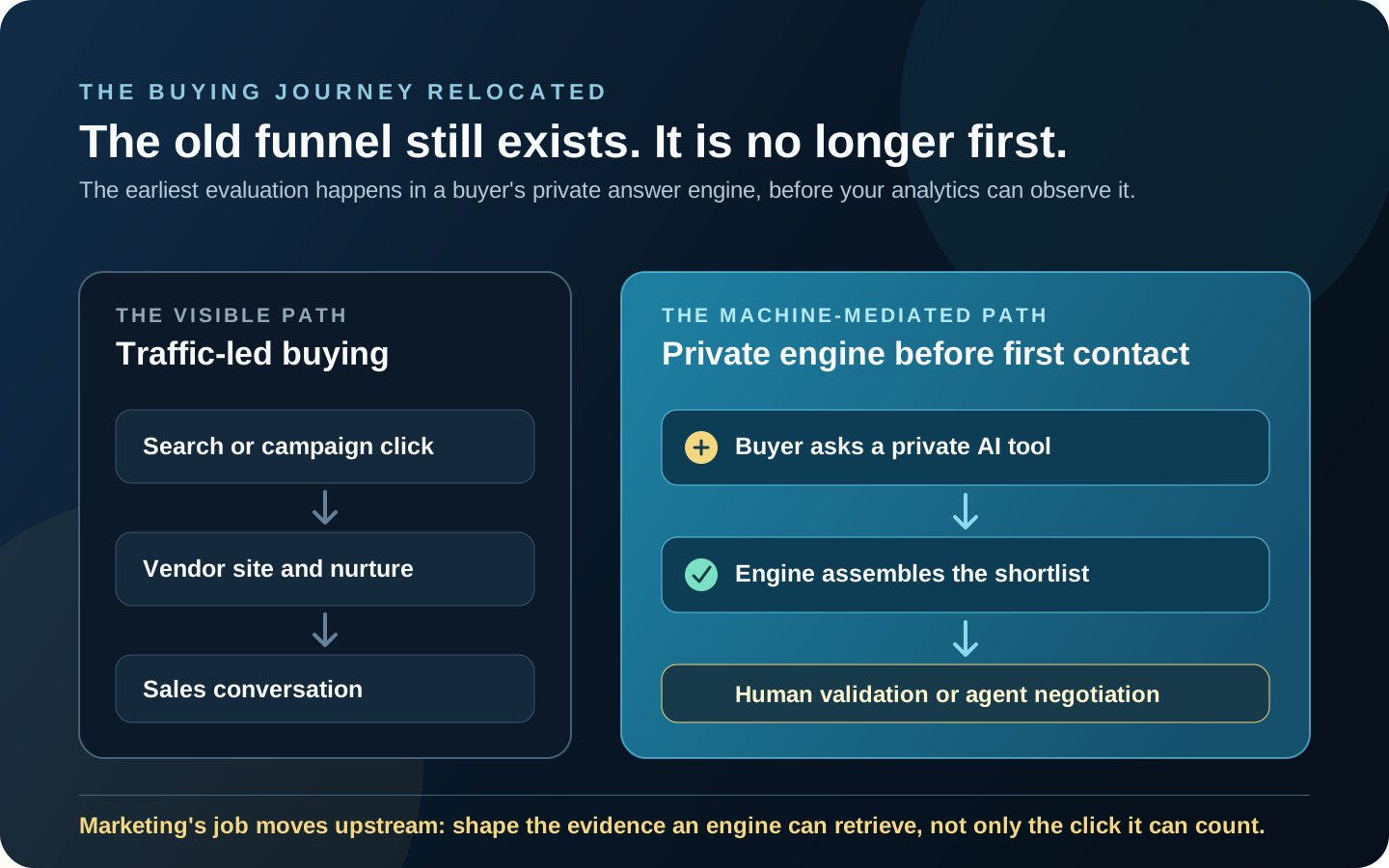
The old funnel was visible enough to optimize. A prospect clicked, read, downloaded, returned, and eventually surfaced as a lead. The new path often begins with a buyer asking an assistant to explain a category, translate a technical need, compare alternatives, or draft a shortlist. The answer can carry a vendor name forward. It can also remove one without leaving a trace in the dashboard.
The early conversation is not necessarily hostile to vendors. In many cases, it is more rigorous than the old search journey. A buyer can ask for a comparison against a specific operating constraint, request a plain-language explanation of a technical dependency, or force the assistant to list where a product is a bad fit. That can be helpful for a serious seller. It also means the seller's claims have to survive a comparison prompt that does not care how much effort went into the landing page.
This is why the familiar debate about whether AI search will send traffic misses the B2B point. A referral is a lagging signal of consideration, not proof that consideration happened. A buyer may arrive later through direct traffic, a colleague's note, a procurement portal, or a sales introduction. Or they may not arrive at all because an answer engine concluded, correctly or incorrectly, that the vendor did not meet a requirement. Visibility inside that first explanation is a commercial input even when it never becomes a web session.
That does not make websites or sales teams irrelevant. It makes them later. The company that treats the website as the first meeting will keep improving an experience that many serious buyers only reach after the first opinion is already set. The company that treats its documentation, independent evidence, and customer record as the first meeting has a better chance of showing up in the machine's version of the category.
The private engine problem.
B2B has a twist that makes this more consequential than a consumer search shift. The buyer's AI is often supplied by the buyer's employer. Forrester reports that 61% of business buyers use private, company-provided AI tools. These environments can sit behind a firewall, mix public sources with internal history, and produce useful work without creating an ad impression, a referral visit, or a remarketing audience for the seller.
The funnel did not leak. It relocated. A private assistant can compare vendors against an internal security checklist, summarize a previous implementation, turn an analyst note into a requirement, and draft the committee's first questions. Marketing cannot see the query or A/B test the answer. That limitation is real, but it is not the same as having no influence.
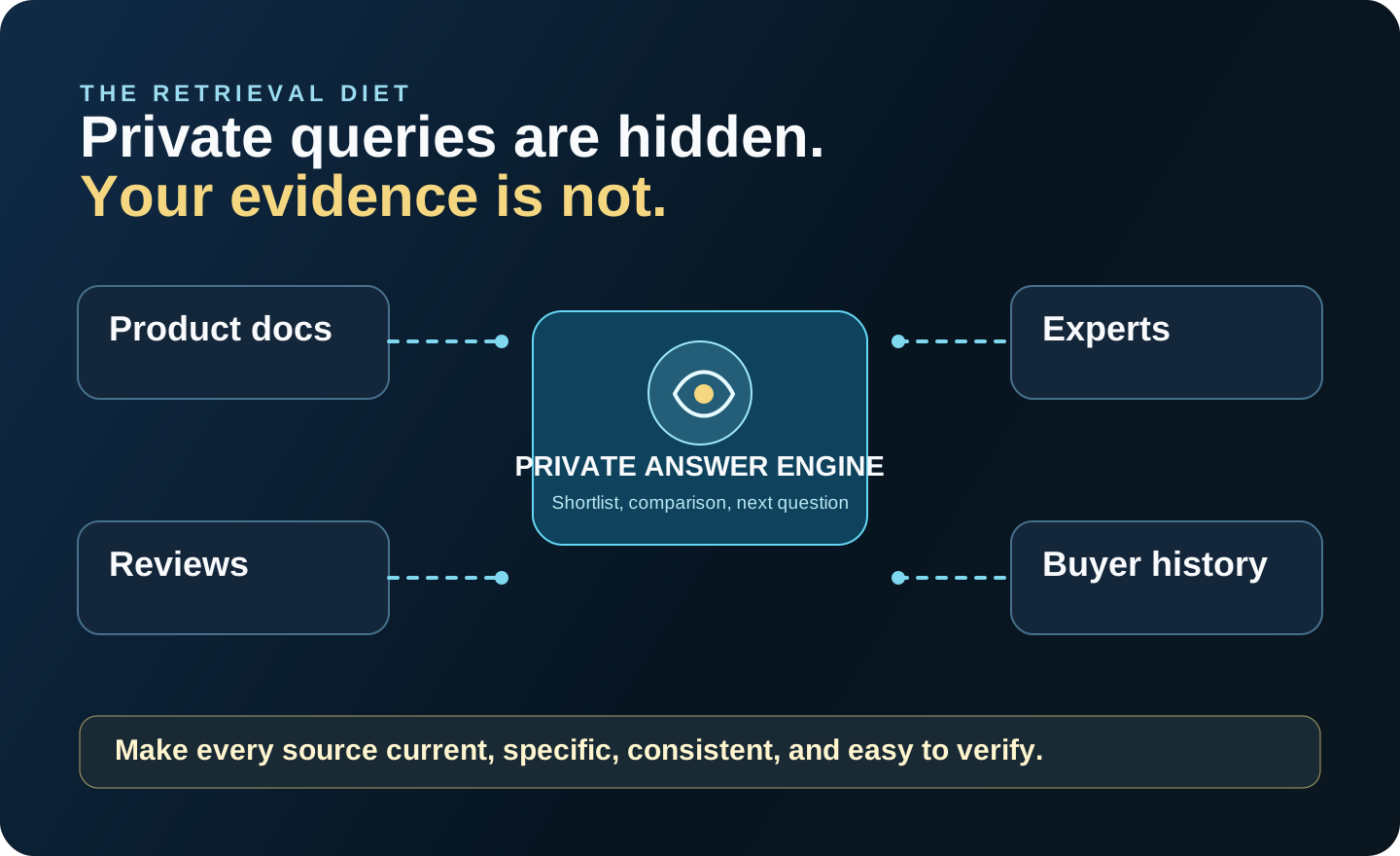
An assistant is constrained by what it can retrieve, which is why the unglamorous parts of brand evidence matter more now. Product documentation needs to be specific and current. Integration, pricing structure, security posture, and implementation limits cannot live only in a sales deck. Reviews, analyst work, expert commentary, and community answers all become part of the evidence a machine may use to decide whether a claim is credible.
Think of this as a retrieval problem before it becomes a copywriting problem. A claim about an enterprise product is only as useful as its surrounding proof. A feature page that names the capability but does not define the deployment model leaves an assistant room to infer. A security page without scope, date, or ownership makes it hard to distinguish a current control from an old promise. A review response that never corrects a known implementation misconception lets that misconception travel. The strongest public source is not the loudest one. It is the source that answers the next reasonable question without creating a contradiction somewhere else.
That makes content operations a cross-functional job. Product, security, support, legal, customer success, and marketing each own facts that a buyer's AI may stitch together. When those facts disagree, the engine does not know which internal team had the better context. It sees conflicting evidence. A useful operating habit is to identify the claims that most often decide a shortlist, assign an accountable owner to each one, and review whether the public evidence still matches the product and customer reality.
Private engines also create an accountability problem for measurement. A dashboard cannot recover a query the seller never receives, but it can show the consequences of a weak evidence layer. Look for categories where direct and branded demand diverge, accounts where a known competitor appears before sales is invited, repeated objections that begin with an inaccurate assumption, or win-loss notes that describe a buyer comparing a version of the product the company no longer sells. Those are clues about the sources feeding the hidden first meeting.
6sense's buyer research gives the point a human dimension: 85% of buyers had direct prior experience with the vendors they evaluated. A private engine does not erase that experience. It makes it easier for past reality, good or bad, to enter a current decision before a polished campaign can interrupt it.

Trust returns to the human.
The committee did not shrink. It gained non-human members that can produce different comparisons before the team ever speaks to a vendor. Three people can ask three assistants, receive three differently weighted shortlists, and bring that disagreement into the room. This is why a generic brand claim has less leverage than a precise explanation of where a product works, where it does not, and what a buyer must verify.
There is a countercurrent that most AI-funnel takes miss. Forrester's 2026 B2B predictions say that 19% of buyers using generative AI feel less confident in their purchase decisions because the information can be inaccurate or unreliable. At the final commitment stage, 30% rated generative AI as meaningful, while 17% rated product experts as meaningful. Forrester expects expert interaction to move earlier as buyers look for deeper validation.
That is an opportunity with a different shape from a demo request. Do not build a human handoff that repeats the shortlist. Build one that lets a buyer test it: a fast answer from the person who knows the edge case, a transparent reference customer, a published implementation constraint, or a way to verify a material claim. The machine wins speed. A credible expert wins the moment a buyer needs to know whether the machine is wrong.
This distinction should change how companies staff the middle of the journey. Too many teams reserve their most credible people for a late-stage sales call, after a buyer has already used an assistant to compress the category into a few generic differences. A better model gives a buyer access to evidence when the comparison is still forming. That can be a short technical clinic, a reference library that answers uncomfortable questions, an implementation review with a practitioner, or a named product expert who can challenge the assistant's framing without resorting to a pitch.
It also requires a healthier relationship with uncertainty. If the product is not right for a particular deployment, say so in a way a buyer can verify. If there is a dependency that changes the total cost or timing, publish it. A machine may repeat an evasive answer once. A buyer who needs confidence will notice the omission. Specific limits are not a weakness in a machine-mediated journey. They are evidence that the company can be trusted when the answer becomes consequential.
Negotiation gets an agent.
Today's change is a buyer asking an assistant for help. The next change is an assistant asking another assistant for a price, a term, or a counteroffer. Forrester predicts that at least one in five B2B sellers will be compelled to respond to AI-powered buyer agents with dynamically delivered counteroffers through seller-controlled agents in 2026. This is not a reason to hand pricing authority to a model. It is a reason to prepare the commercial information that a controlled agent, and a human reviewer, would need.
Machine-mediated negotiation exposes the parts of an offer that companies have long kept informal. Packaging definitions, discount boundaries, implementation prerequisites, service-level exceptions, security requirements, and approval limits all need a legible form. If a buyer's agent cannot understand the term, it will either ask a human, retrieve a partial answer from elsewhere, or remove the vendor from the comparison by default.
The useful preparation is not "turn on an agent." It is to map which terms can be explained automatically, which need evidence attached, which require a named approver, and which can never be changed without a person. The same work improves a normal procurement conversation. It simply becomes more urgent when a buyer's first negotiator has no patience for a vague PDF and no reason to infer what a seller meant.
Start with the moments that already create friction in a normal deal. Which implementation questions require a sales engineer to interpret the contract? Which pricing exceptions are commonly approved but never written down? Which security requests depend on a customer's industry or geography? Which promises create downstream work for customer success? Those are the places where an agent must either retrieve a current, governed answer or stop and escalate. Turning them into inspectable decision rules reduces cycle time for people today and prevents a future system from making an expensive assumption on its own.
The seller's job is not to make every commercial decision automatic. It is to make the boundaries unmistakable. A controlled response can show a standard package, explain the condition attached to a discount, request missing context, and route an exception to the owner who can approve it. That is far more defensible than an assistant improvising a counteroffer from old collateral. The more precise those boundaries are, the less likely a buyer's agent is to interpret ambiguity as a reason to exclude the vendor.
The standards behind that exchange are still forming. That uncertainty is not a license to wait. It is a reason to start with bounded authority, current evidence, and clear escalation points. Authorization is part of the commercial design, especially once an agent can propose or accept a term that affects revenue.
What marketing changes now.
The response is not to chase every assistant. It is to make the buyer's evidence trail strong before an assistant summarizes it.
Measure share of answer
Track how major assistants describe the category and your brand. Capture recurring gaps, unsupported claims, and missing proof. A visit is no longer the only sign that discovery happened.
Fix the retrieval layer
Publish the details a serious buyer needs: exact product scope, integrations, security, pricing logic, constraints, owners, and dates. Make contradictions easy to find and remove.
Treat third-party proof as infrastructure
Reviews, analyst coverage, independent expert work, and customer evidence carry more weight when a machine is deciding whether a claim can be trusted.
Productize validation
Give buyers access to credible people and proof before the final stage. The human touchpoint should resolve uncertainty, not recite the sales narrative.
Make terms ready to inspect
Document what can be quoted, changed, approved, or escalated. That improves the human buying process now and makes agent negotiation controllable later.
This is why the traffic conversation needs a reset. A team can be correct that organic visits are down and still miss the more important question: did the brand appear in the answer that shaped a shortlist? The broader consumer-side pattern is visible in the AI visibility trap. B2B adds an extra problem because private engines hide a large part of the new journey from measurement.
Do not solve that by inventing certainty. Use directional signals, assistant-referred visits, branded search, win-rate patterns in accounts known to use purchasing engines, and recurring share-of-answer checks. Then use the evidence to change an owner's next decision: which documentation needs work, which product claim needs proof, which expert should be available, and which commercial term is too vague to survive a machine-mediated comparison.
The reporting change matters as much as the content change. A monthly traffic report can tell a CMO that demand is becoming harder to observe, but it cannot tell the business whether its market explanation is improving. Add a review of the actual answers buyers are likely to encounter. Ask the same high-intent questions across the assistants the market uses. Record the sources cited, the claims repeated, the competitors included, the assumptions that need correction, and the proof that is missing. Assign every material gap to an owner with a date, not to a generic AI visibility workstream.
Then protect the difference between improving evidence and manufacturing a story. A company does not gain durable machine visibility by spraying pages across the web or trying to force a model into a preferred conclusion. It gains it by making real facts easier to retrieve and validate than stale or vague alternatives. That work is slower than a campaign launch, but it compounds. The same accurate implementation page can help a buyer, a sales engineer, a support team, an analyst, and an answer engine reach the same conclusion for the right reason.

The machine may start the meeting. Your evidence decides whether you're invited in.
FAQs
How many B2B buyers use AI during a purchase?+
Forrester's 2025 Buyers' Journey Survey found that 94% of business buyers used AI in their most recent purchase. The more important finding is that twice as many buyers named generative AI or conversational search as their most meaningful information source than any other source.
What is a private AI purchasing engine?+
It is a company-provided AI tool, such as a private ChatGPT or Copilot deployment, that employees use behind the firewall to research, compare, and evaluate vendors. Forrester reports that 61% of business buyers use these private tools, so many early buying interactions leave no vendor analytics trail.
How can a B2B company influence what AI tools say about it?+
Improve the evidence an engine can retrieve: current product documentation, clear integrations and security information, credible reviews, independent analyst or expert coverage, and consistent answers to common buying questions. The goal is not to control a private query. It is to make the available evidence accurate and easy to verify.
Is AI-to-AI negotiation a real B2B sales issue yet?+
It is moving from a future possibility to a planning requirement. Forrester predicts that at least one in five B2B sellers will be compelled to respond to AI-powered buyer agents with dynamic counteroffers through seller-controlled agents in 2026. That makes machine-readable commercial terms and human approval guardrails practical preparation, not speculative infrastructure.
Do human experts still matter in an AI-led buyer journey?+
Yes. Forrester reports that 19% of buyers using generative AI feel less confident because AI information can be inaccurate or unreliable. The high-value human moment is not repeating the machine's shortlist. It is helping a buyer validate a material claim, implementation condition, or tradeoff before a commitment is made.