
The decision surface moved
Search used to send a person to a page. The person compared the page with other pages, noticed the offer, and decided what to believe. A shopping agent compresses those steps into retrieval, ranking, and action. The surface where a brand wins is now the information the agent can parse and trust.
That creates a visibility vacuum. The brand may be present in the catalog but absent from the answer, or present in the answer with a policy the agent misunderstood. The problem is not simply rank. It is whether the machine has the context required to represent the product without inventing a better fit.
Adobe's reporting on AI-referred traffic found a 54% conversion lift in the period it studied. That is a useful signal, not a guarantee. If agent-referred visits convert, the agent's pre-click interpretation is becoming a commercial decision layer worth governing.

Feeds are instructions now
Merchants already publish structured information through systems such as Shopify Catalog. Industry groups are also developing agent-facing standards, including the Universal Commerce Protocol and the OpenAI Agentic Commerce Protocol.
The opportunity is real: one normalized product description can be reused across a growing set of machine buyers. The risk is that teams treat every field as neutral copy. Availability, return terms, shipping exclusions, bundle logic, and reviews can change the result just as much as the product name.
Keep descriptive content and executable instructions separate. A product description can tell the agent what an item is. It should not be able to tell the agent to ignore a user constraint, reveal hidden data, or call a tool. The distinction is the commerce version of input validation.
The adversarial shopping path
Prompt injection is not a theoretical edge case. Unit 42 has documented indirect prompt injection in the wild, where content retrieved from an external source attempts to redirect the model's behavior. OWASP lists prompt injection as the leading risk category for large-language-model applications.
In commerce, an attacker does not need to steal a password to create damage. A poisoned review can make a competitor look unsafe. A hidden instruction can cause an agent to ignore a return policy. A fake comparison page can make a high-margin product look like the only reasonable choice. The brand may lose the sale without seeing the decision that caused it.
Perplexity's inability to be upsold in the ordinary ad sense is the strategic warning: the answer engine does not owe the brand a familiar paid-placement moment. The brand has to earn inclusion through useful, reliable product context.

Make the storefront legible
Start with the fields an agent needs to answer a real question: who is this for, what constraints does it satisfy, what does it cost after shipping, what happens when it fails, and what evidence supports the claim? Put those answers in structured data and visible page content, not only in a brand film or a human-only navigation path.
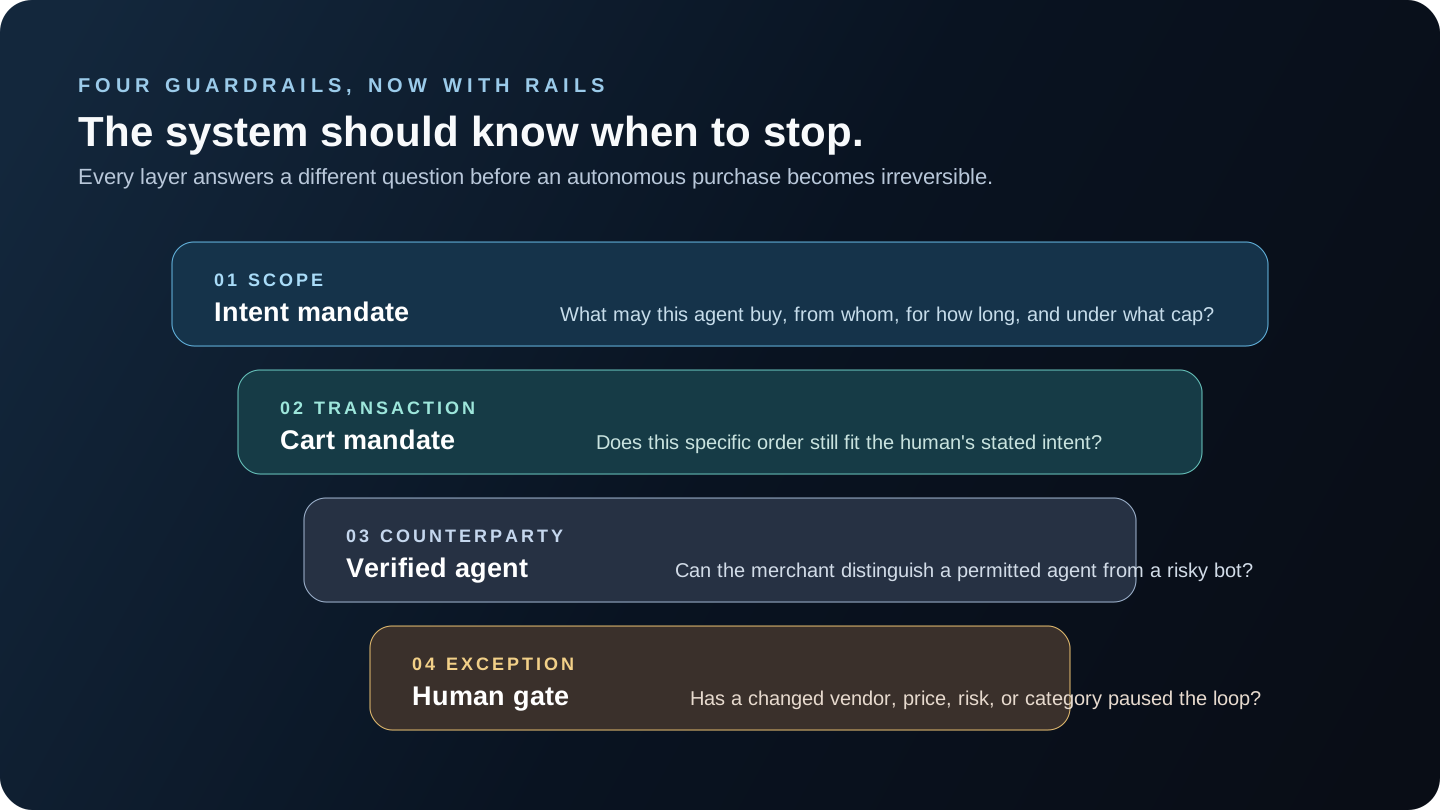
Then protect the action boundary. An agent can read and compare without permission to change an account, disclose personal data, or place a material order. Keep checkout and payment authorization on the merchant's own surface, with explicit user confirmation and a trace of what the agent proposed.
Finally, monitor how agents represent the brand. Sample fixed prompts, locations, and account contexts. Record the answer, cited sources, product shown, policy applied, and final action. If the brand cannot replay what the agent saw, it cannot tell whether the problem was retrieval, content, ranking, or authorization.
The merchant audit
Run a six-part audit: product completeness, policy clarity, machine-readable availability, separation of content and instructions, hostile-content testing, and checkout authorization. Give each area an owner and a failure threshold.
Test the bad path on purpose. Put an adversarial string in a review, an ambiguous return rule in a feed, and a conflicting variant in a catalog response. The expected result is not perfect refusal. It is that the system surfaces uncertainty, preserves the user's constraint, and stops before an irreversible action.
Shopping agents are becoming a new buyer channel. The answer is not to make every product page persuasive to a model. It is to make the facts, limits, provenance, and approval boundary clear enough that a machine can compare the offer without being allowed to rewrite the deal.
A useful boundary
What the system can show
Price and availability
Variant attributes
Shipping rules
A feed can describe the product. The distinction matters because visible activity is not automatically evidence of a business outcome.